Cartridges that Brought Their Own Channels
Konami's VRC6, Sunsoft's 5B and Namco's 163 added voices from inside the cartridge, which is why some Famicom titles sound impossible on a stock console.
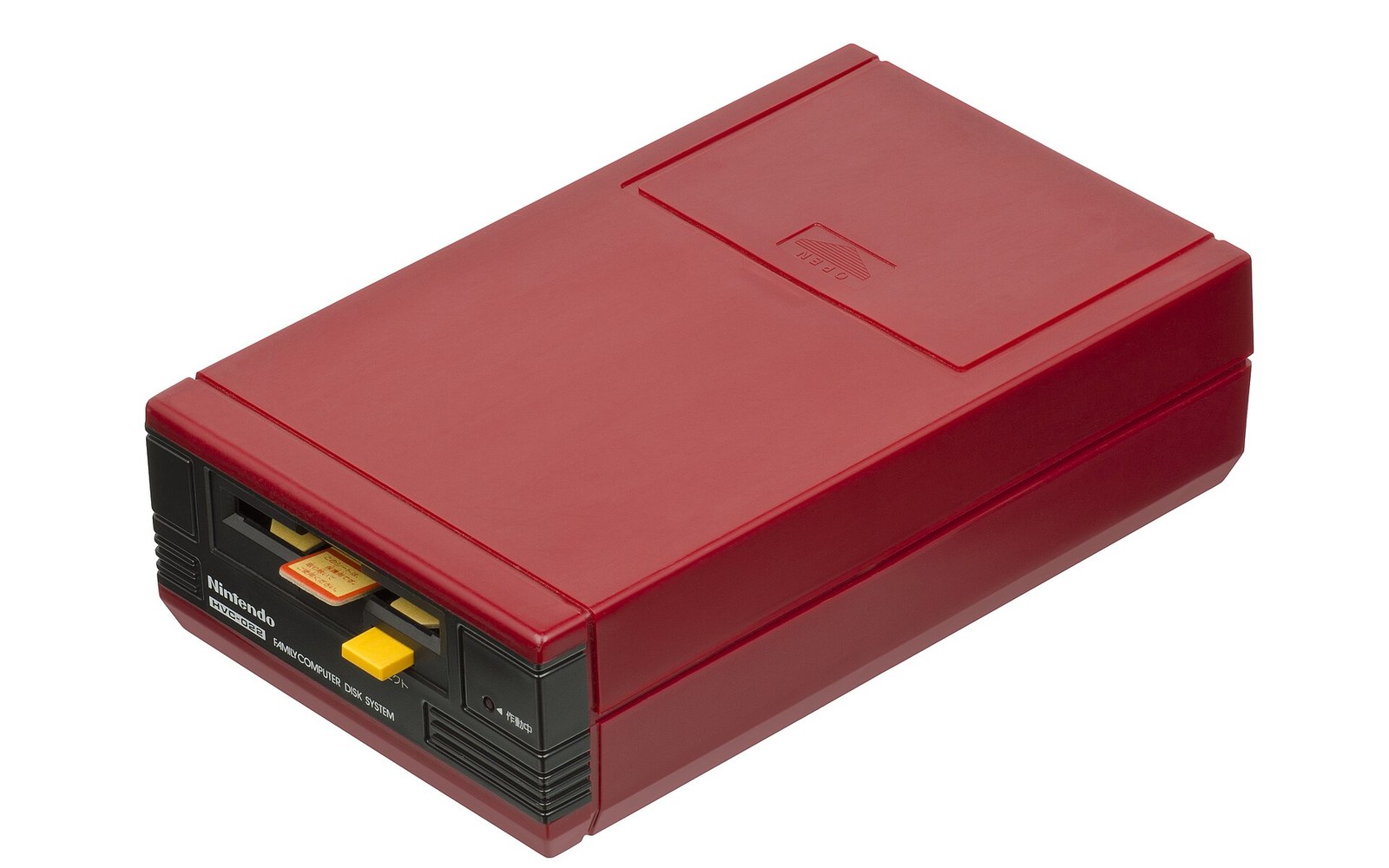
When the cart was also the sound card
Some Famicom titles sound like they belong on a different machine entirely. Akumajō Densetsu arrives with a six-voice organ-plus-pulse texture that the stock console could never produce. Gimmick! builds layered melodies over the standard five channels that seem to multiply before your ears. The reason in every case is the same: the cartridge PCB itself is generating audio.
Nintendo's expansion audio header — pin 46 on the cartridge connector, routed into the Famicom's main board and mixed before it reaches the output — was present by design. The console's engineers left the door open, and three third-party chip-makers walked through it: Konami with the VRC6, Sunsoft with its 5B, and Namco with its 163. Each brought a different philosophy, and the sounds they made are as distinct as the manufacturers.
Three chips, three different bets
Konami's VRC6 is the most focused of the three. It adds two pulse channels and a sawtooth generator, doubling the pulse capacity of the stock console and adding a sawtooth whose amplitude is adjustable, unlike the 2A03's triangle wave, which carries no volume control whatsoever . The two extra pulses offer eight duty-cycle settings, twice as many as the 2A03's own pulse channels, so a composer using all of them simultaneously could layer four pulse waves with independent pitches and envelopes. The sawtooth, meanwhile, is capable of a warm, slightly buzzing bass or a cutting lead depending on how the accumulator register is written: the chip generates the wave by incrementing an internal value that resets at the top of each cycle, and the rate of that increment determines the slope and therefore the timbre. Konami used the VRC6 in Akumajō Densetsu (the Famicom release of what the West knew as Castlevania III) and in Madara, and Kinuyo Yamashita and Satoe Terashima's score for the former became the benchmark against which every other expansion audio title is measured.
The Sunsoft 5B is a more extravagant choice in a different direction. Where Konami kept the VRC6 purpose-built and economical, Sunsoft licensed a Yamaha YM2149F, the same three-voice PSG that was driving the Atari ST and various arcade boards at the time. That made the 5B effectively a General Instrument AY-3-8910 derivative — three square-wave voices, a shared hardware envelope generator, and a noise channel — wired into the Famicom's expansion pin. The result, in Gimmick! (titled Mr. Gimmick on its 1992 release), is a score by Masashi Kageyama that stacks AY-style square waves above the 2A03's own channels for an orchestral density the hardware never anticipated. The 5B's envelope generator operates independently of the CPU on a per-chip basis, meaning long, smooth amplitude shapes that the 2A03's four-step software envelopes could not easily replicate. The catch: Sunsoft used the 5B in exactly one game. The chip was expensive, the cartridges were expensive, and Gimmick! remained a rarity.
The Sunsoft 5B is a more extravagant choice in a different direction.
Namco's 163 — sometimes called the N163 — is the strangest of the three and arguably the most powerful. Rather than producing fixed waveforms, it gives the composer a 128-byte wave RAM and up to eight independent voices, each playing back whatever waveform is loaded into that shared memory. That makes it a wavetable synthesiser in miniature: a four-sample sine approximation costs almost nothing in RAM; a more complex waveform fills more of the space; using all eight channels simultaneously forces all eight to share the same 128 bytes, so the composer is constantly trading voice count against waveform complexity. Sunsoft's approach was take-it-or-leave-it; Namco's was a puzzle the programmer had to solve per title. The 163 appears in Splatterhouse: Wanpaku Graffiti, Erika to Satoru no Yume Bōken, and in Megami Tensei II, where the extra wavetable voices give the score a fuller texture than the stock chip alone could manage.
Why it stayed Famicom-only
None of this reached the NES in any meaningful way. Nintendo of America's cartridge connector omitted the expansion audio pin, which means every game that used VRC6, 5B or 163 audio lost those extra voices when it crossed the Pacific. Castlevania III on NES runs on the 2A03 alone. The difference is immediate and jarring if you know the Famicom version: Yamashita's multi-layered organ textures collapse into the standard five channels, and the sound designers' original intentions go with them. This wasn't a localisation oversight so much as a hardware policy: the NES connector was a deliberate redesign, and the expansion audio header simply was not part of it.
The Famicom's openness in this one respect — the presence of pin 46 — was itself a historical accident of timing. Nintendo designed the system in 1982–83 for a domestic market where cartridge hardware diversity was expected, before the company's later tendency toward tighter platform control had fully formed. By the time expansion audio was flourishing in the late 1980s and early 1990s, the NES had already shipped in its locked-down form and the architectural split was permanent.
The emulation and revival argument
For the chiptune and tracker community, the three chips represent three distinct dialects that FamiTracker and its 0CC fork support as selectable expansion hardware. Writing for the VRC6 means thinking in pulse pairs and sawtooth bass; writing for the 5B means understanding how the AY envelope generator shapes amplitude over time; writing for the 163 means managing wave RAM as a shared resource and accepting that more voices means coarser waveforms. Each imposes constraints that are genuinely different from the base 2A03's constraints, which is why composers who care about authentic sound design treat expansion audio as its own discipline rather than as a simple upgrade.
Emulation accuracy matters here more than almost anywhere else in the 2A03 ecosystem. The 163's timing interacts with the main CPU in ways that early emulators reproduced incorrectly — a voice allocation quirk that affected which waveforms played when the RAM was being written during active playback — and getting that detail right required cycle-accurate CPU emulation alongside the expansion chip model. The VRC6's sawtooth has its own accumulator-reset artefact that a simple square-wave model misses. These are not audiophile subtleties; they are the difference between hearing what composers actually wrote and hearing a reasonable approximation of it.

What the expansion chips demonstrate, in the end, is that the 2A03's apparent ceiling was a floor: the cartridge slot was always a potential extension of the sound hardware, and the composers and engineers who understood that produced work that still sounds unlike anything the base chip could have managed on its own. The console's architecture drew the box. These three chips quietly drew a larger one around it.