A bass line you cannot make quieter
The triangle channel has no volume envelope at all, which is why NES bass either plays or stops, and why composers used it for percussion as well.
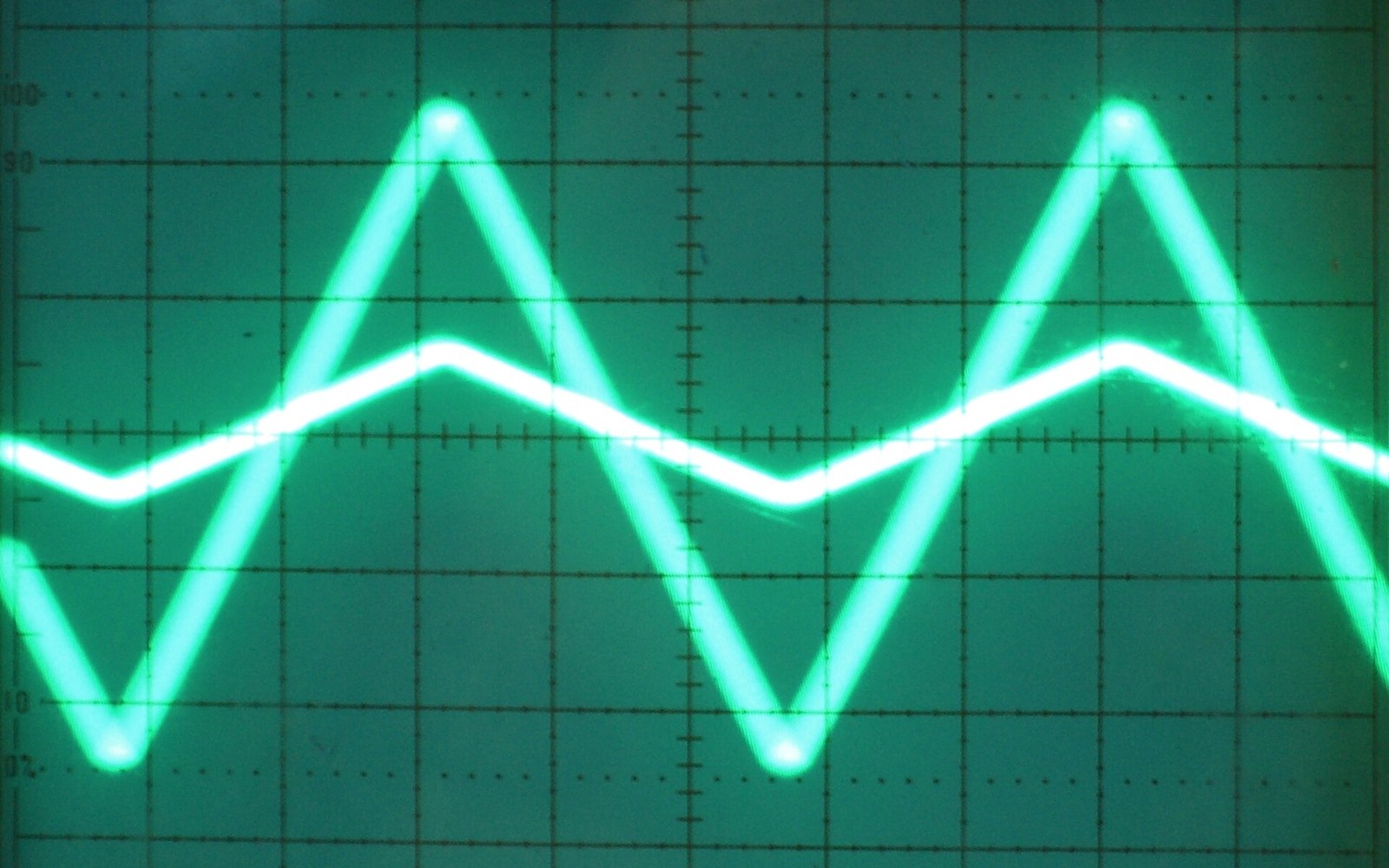
The one channel that lives at full volume
The triangle wave is the 2A03's workhorse for bass and melody, and it has no volume control whatsoever. Not a weak one, not a limited one — none. The channel outputs at a fixed amplitude, always. Every bass line you have heard on a Famicom or NES is either sounding at full strength or switched off entirely, and the composers who built careers on that hardware learned to treat it not as a limitation to work around but as a constraint that shaped a whole aesthetic.
The reason sits in the silicon. The 2A03 integrates its audio unit directly onto the CPU die, a decision driven by cost, and the triangle channel's design reflects that parsimony. Where the two pulse channels carry a 4-bit volume register that feeds a simple DAC, the triangle channel bypasses that circuitry entirely. Its output is a 4-bit, 32-step staircase waveform — the lowest-resolution triangle the hardware could produce — running at whatever frequency the pitch register dictates, always at the same loudness. Ricoh's 2A03 documentation, preserved and annotated by the NESDev community, confirms the channel carries a linear counter for gating and a length counter for note duration, but no means of scaling amplitude.
What this gives composers is a binary choice: the bass note is on, or it is not. Fade-outs, swells, accented downbeats — none of those are available on this channel. The pulse channels can simulate a crude envelope by stepping their volume register down in code, which is why leads and countermelodies carry more expressiveness. The triangle sits underneath them, unwavering.
What this gives composers is a binary choice: the bass note is on, or it is not.
Playing silence like a note
Composers adapted in two directions. The first was rhythmic: if you cannot make a note softer, you can make the gap between notes do the work. Sunsoft's composers became especially skilled at this, writing bass lines where the rests are as deliberate as the pitches — the silence functions as articulation because the note itself cannot be shaped any other way. The bass breathes through its gaps.
The second adaptation was percussive. Because the triangle produces a fixed-amplitude output and can be switched on and off in code at sub-frame resolution, it behaves like a drum trigger. Composers routed very short triangle bursts — often two to four frames at a low frequency — to simulate kick drums and tom hits, filling rhythmic space the noise channel could not cover on its own. Hirokazu Tanaka used exactly this technique across several of his scores, treating the triangle as a second percussion voice rather than a harmonic one, weaving it against the noise channel's snare-like output to build rhythmic structures that sounded considerably richer than a two-element kit should.
Koji Kondo's approach on Super Mario Bros. is perhaps the most studied instance of the first strategy. The walking bass lines under the overworld theme are phrased with careful rests that imply articulation — short, clipped notes that make the channel sound more responsive than its hardware actually permits. The illusion holds because the ear is already tracking the pulse channel melody; the triangle's relentlessness becomes a stable floor rather than an obvious flaw.

Fixed amplitude, unfixed thinking
The constraint also had an indirect tonal consequence. Because the triangle always plays at the same level relative to the pulse channels, the frequency balance of any 2A03 mix is essentially predetermined. Bass will always sit at the same weight; composers could not push it forward or pull it back in the mix by attenuating the channel. The non-linear mixing of the 2A03's internal DAC, documented in teardown analysis by the NESDev community, adds a further wrinkle: the triangle and DPCM channels feed a separate summing network from the pulse channels, so the relative loudness of bass versus melody is a hardware artifact, not a compositional decision.
It is the kind of limitation that looks like poverty and turns out to be identity.