The Noise Channel Is a Shift Register Pretending
Noise comes from a linear-feedback shift register with a short mode that produces a metallic pitch rather than a hiss — which is why NES drums sound like that.

It has fifteen pitches, two modes, and zero actual randomness
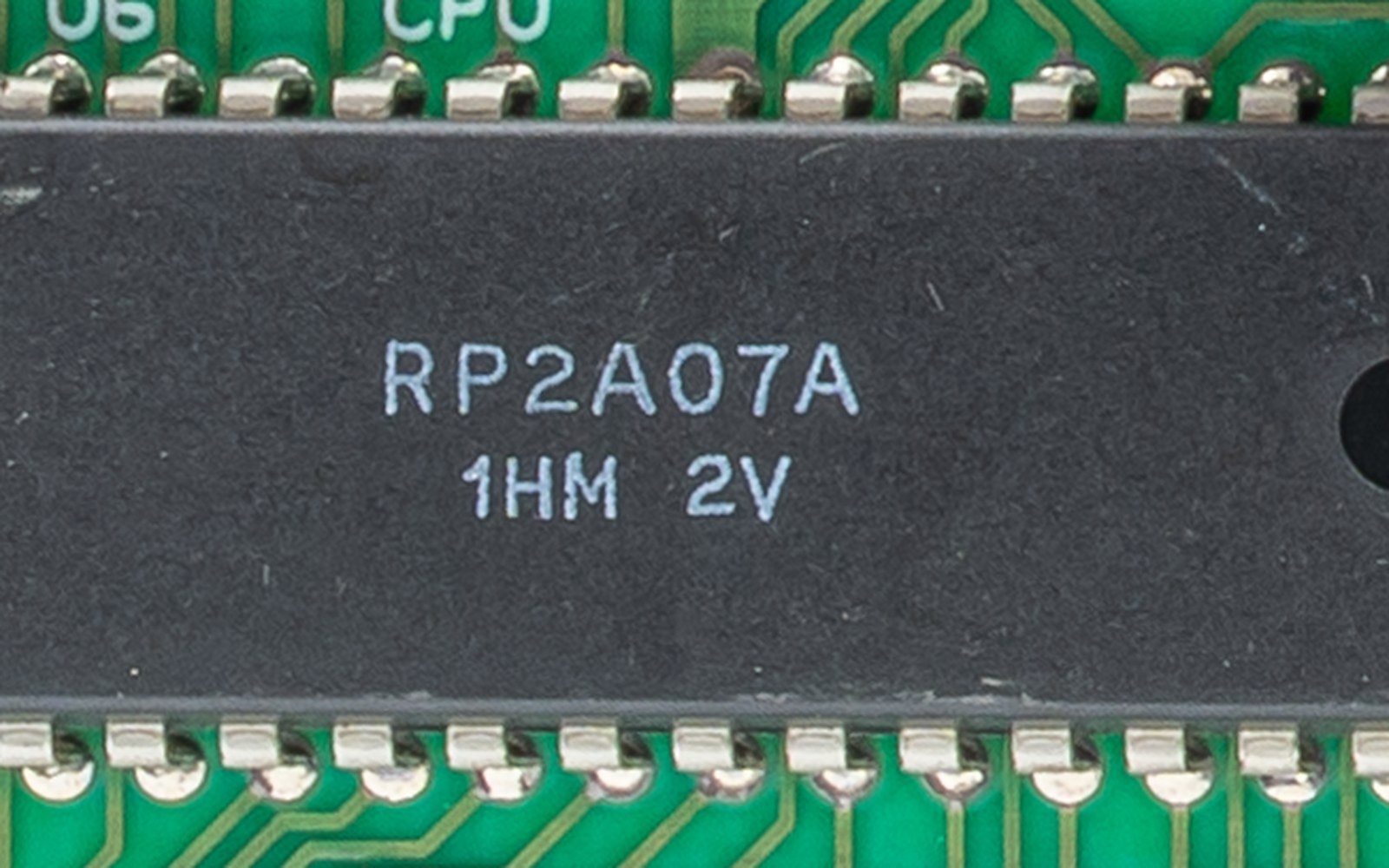
The 2A03's noise channel does not generate chaos. It generates a linear-feedback shift register sequence — a 15-bit loop that cycles through 32,767 states before repeating. At audio rates, that repetition period is long enough to read as white noise. The hardware is, in a precise sense, lying to you.
The register clocks at one of sixteen selectable frequencies, set by a 4-bit period register. Slower clocks push the noise toward a low rumble; faster ones produce the crisp hiss used for hi-hats and snare. A volume envelope identical to the pulse channels' can shape the attack and decay, which is why NES percussion has that characteristic fast-decay snap rather than the sustained wash you'd get from an analogue noise source.
The mode bit is where things get strange. In default mode the register feeds back through XOR of its two lowest bits, yielding a pseudo-random sequence long enough to sound stochastic. Flip the mode bit and the feedback taps bits 1 and 6 instead. The register now cycles through only 93 states before repeating — short enough that the output has a definite pitch, a thin metallic ring. Every NES composer who needed a tom-like sound or a buzzing effect reached for this mode. The specific pitches available are not musical ones; they sit in the gaps between standard tuning, which is exactly what makes them sound so distinctly synthetic.
Hirokazu Tanaka used the short mode's metallic textures throughout Metroid to suggest machinery and alien threat.
Hirokazu Tanaka used the short mode's metallic textures throughout Metroid to suggest machinery and alien threat. Sunsoft's composers, writing for titles like Batman (1989), drove the noise channel harder than almost anyone — pairing envelope-shaped hiss with short-mode pings to construct percussive patterns that sound fuller than a single voice has any right to. Composers working on the Famicom quickly learned that the channel's fifteen pitches weren't a limitation so much as a fixed palette, and that working within a fixed palette is a skill in itself.
What you cannot do is straightforward: no pitch glide, no arbitrary frequency, no true randomness. The 2A03's register, described in the RP2A03 technical documentation, is completely deterministic — the same period value produces the same waveform every time. Trackers and NES composers learned to exploit that predictability, hitting the same short-mode note repeatedly to simulate a pitched drum, or riding the envelope to carve a snare out of what is, underneath, a very fast counting loop.