A chip with filters, and a personality to match
The Commodore 64's SID has three voices but a resonant filter and real envelopes, so its music sounds nothing like the NES despite the same era.
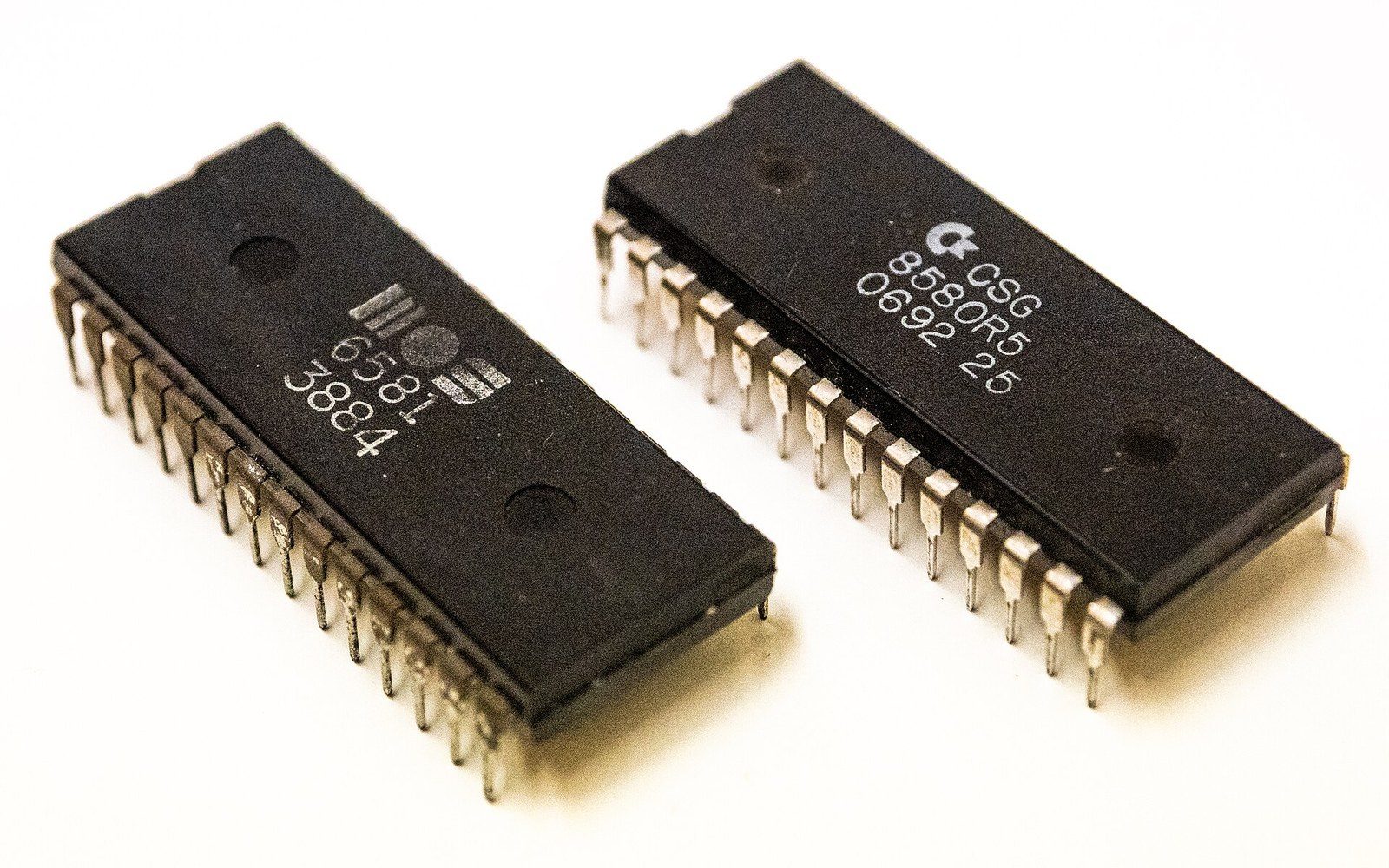
The SID is not trying to do what the 2A03 does
The MOS Technology 6581 — the SID chip inside the Commodore 64 — has three voices to the 2A03's five channels, which on paper looks like a step down. In practice, the two chips are so differently designed that comparing voice counts is almost beside the point. The 2A03 gives a composer raw waveforms and leaves timbre to the arithmetic of the hardware; the SID gives a composer a resonant filter and real analog envelopes, then hands them something closer to a synthesiser than a tone generator. The music that came out of each machine sounds the way it does because of decisions made at the silicon level, years before any composer sat down with either chip.
The SID was designed by Bob Yannes and went into the Commodore 64 at launch in 1982. Yannes had wanted to build a proper synthesiser in a chip, and the architecture shows it. Each of the three voices has its own oscillator — pulse, sawtooth, triangle or noise, or a ring-modulated combination — plus a dedicated ADSR envelope: attack, decay, sustain, release, with each stage independently programmable. Compared to that, the 2A03's volume envelope is a four-bit decay-only structure with no sustain or release stage. The difference in expressive range is not subtle. A SID voice can swell in slowly, hold its level, then release over a long tail; a 2A03 pulse channel fires and decays, and the composer has to simulate sustain by retriggering notes at volume.
Then there is the filter. The 6581 routes all three oscillators through a single shared analog filter — a state-variable design giving low-pass, high-pass and band-pass modes, with a resonance control that can push the filter into that characteristic squelchy, singing quality. The 6581's filter is analog in the strictest sense: the cutoff frequency is set by a voltage, not a number, which means the filter's behavior varies slightly between individual chips. That variance became part of the SID's personality. Two 64s sitting side by side could sound perceptibly different on the same software, and composers who worked extensively with the chip developed strong preferences for particular chip revisions.
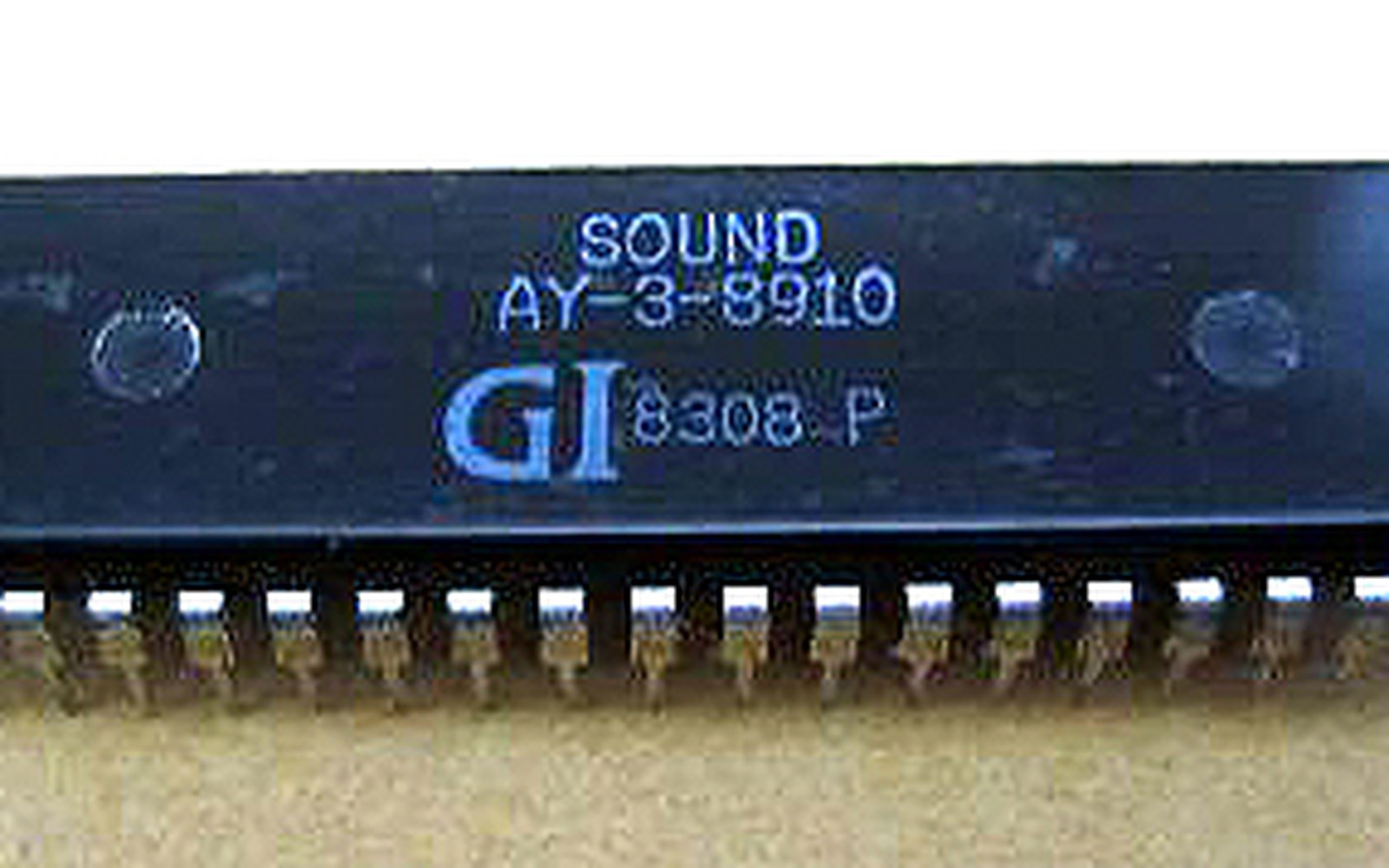
The 2A03 has no filter of any kind in the audio path. What comes out of the mixer — itself a non-linear analog stage, but not a programmable one — is the raw waveform at the programmed volume. Timbre is fixed by channel type. If a pulse channel sounds too bright, there is nothing to turn.
What composers built inside those limits
Because the SID is more expressive per voice, SID composers could coax sounds from three voices that would be difficult or impossible on five 2A03 channels. Rob Hubbard, whose scores for titles including Monty on the Run and Commando defined the mid-1980s C64 sound, worked the filter as a real-time parameter — sweeping cutoff across phrases to change texture mid-note in the way a synthesiser player would use a knob. The result has a flowing, almost legato quality that contrasts sharply with the more percussive, staccato character of most NES music, where envelope behaviour pushes composers toward short, retriggered notes.
The SID was designed by Bob Yannes and went into the Commodore 64 at launch in 1982.
Tim Follin, who composed for both platforms across his career, noted in documented interviews that the SID's envelope hardware freed him from the retriggering strategies that NES composition required. On the NES side, techniques like rapid arpeggios — cycling through notes fast enough to imply harmony on a single channel — exist specifically to compensate for what the hardware cannot sustain. The arpeggio trick is a workaround elegant enough that it became an aesthetic in its own right, but it is still a workaround. The SID, with true sustain and a filter to shape harmonic content, does not need it in the same way, and SID music is often less rhythmically dense at the compositional level because the timbre does more work.
Ben Daglish, another prolific C64 composer, favoured the chip's ability to use one voice as a bass line with a low-pass filter cut, a second as a melodic lead, and a third doubling harmony — the filter simultaneously shaping each because it sits downstream of all three oscillators. The practical limit is that composers could not filter voices independently; the filter applies to whichever oscillators are routed into it, collectively. That is a real constraint, but a manageable one compared to the 2A03's fixed timbres.
Why the 2A03 sounds like the 2A03
None of this makes the SID the better chip in an absolute sense. The 2A03's constraints forced a different kind of discipline. Composers like Koji Kondo, working on Super Mario Bros., built scores where melodic clarity and rhythmic drive compensated for timbral limitation — the theme is identifiable on a single pulse wave because the melodic writing is that strong. Hirokazu Tanaka's work on Metroid used the noise channel and triangle wave in ways that the SID's richer vocabulary might not have demanded: the restriction became the aesthetic. The triangle channel's total absence of volume control is an engineering compromise that turned into a signature sound.

The SID's analog filter also introduced a fragility the 2A03 never had. The 6581 revision had well-documented instability issues including filter leakage — some voices bleed through the filter path even when nominally switched off — and the cutoff frequency is nonlinearly related to the register value, so the mapping from code to actual pitch is irregular. The later 8580 revision, introduced in 1987 for the Commodore 64C, corrected some behaviours and introduced others; SID composers who cared about chip version were not being precious. They were accounting for real hardware variation.
The 2A03 is, by comparison, deterministic. The same register write produces the same sound on every chip. That predictability is what made emulation accuracy a tractable problem for NES audio and what makes tracker work in FamiTracker feel connected to real hardware rather than to an approximation. The SID's analog filter means that a perfectly accurate software emulation of the 6581 is, in a strict sense, impossible — the silicon varies unit by unit.
The two chips represent genuinely different design philosophies arriving at the same moment. The SID was a synthesiser engineer's attempt to put studio capability into a consumer chip; the 2A03 was a cost-optimised audio block integrated onto the CPU die to minimise part count in a toy-price game console. Both choices shaped the music that came out of them so completely that, three decades later, the sound of either chip is immediately recognisable — not because composers overcame the hardware, but because they learned its specific character so thoroughly that the limits became the style.