A fourth channel, and headphones
The Game Boy's audio adds a wavetable channel and, crucially, was heard through headphones — which changed how people wrote for it.
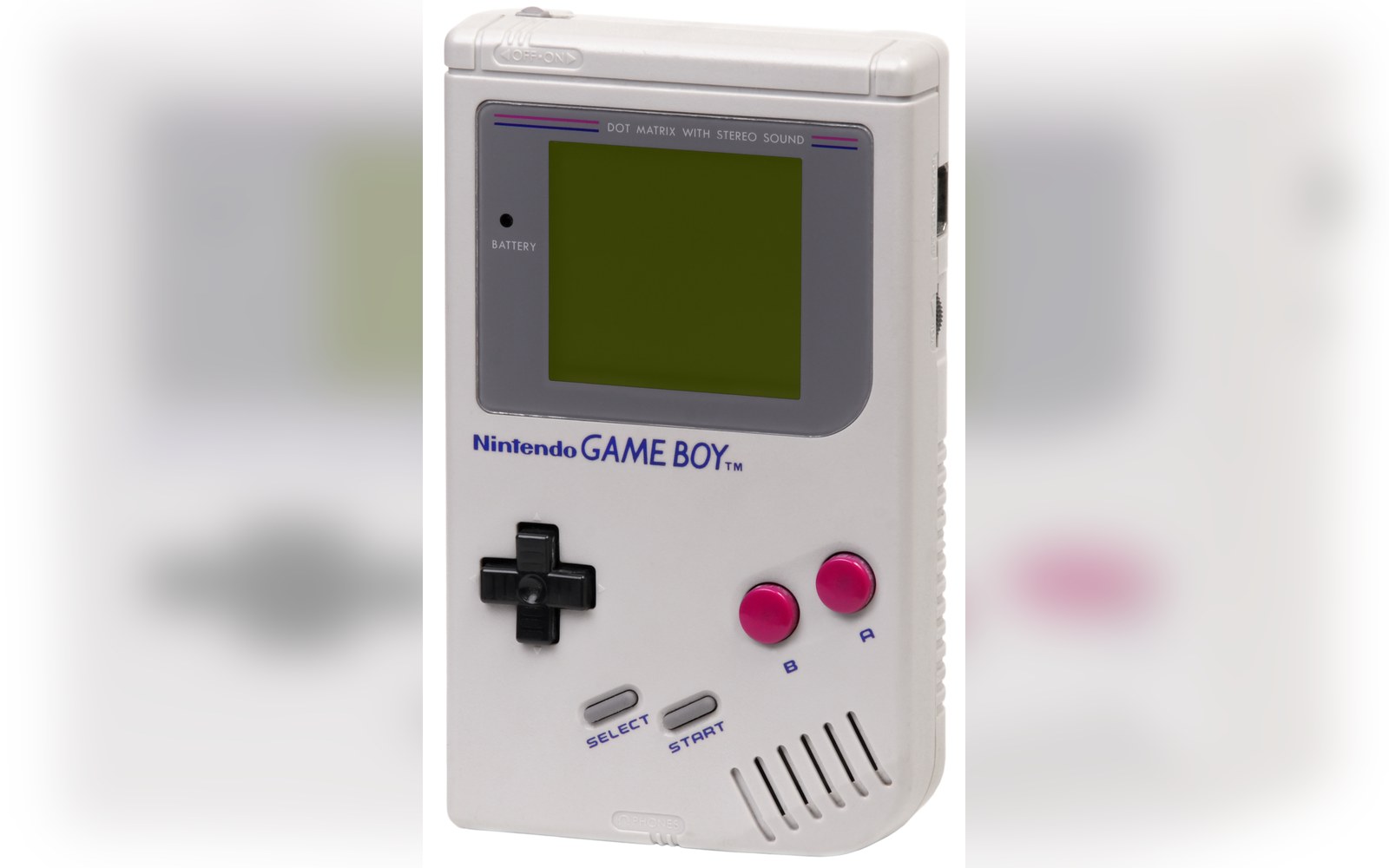
The hardware Nintendo shipped to a pocket
The Game Boy's audio processor sits inside the LR35902, the custom Sharp chip that drove the handheld when it launched in 1989. Structurally, it owes obvious debts to the 2A03: two pulse channels with selectable duty cycles, a noise channel built on a linear-feedback shift register, and a master mixer. Where it diverges is channel three — a wavetable channel that plays back a 32-sample, 4-bit waveform loaded into RAM, cycling continuously at a pitch set by a frequency register. The 2A03's triangle wave is fixed in shape and fixed in amplitude; the Game Boy's wave channel lets a composer write any repeating waveform they like into that RAM and hear it play back. That is a meaningful expansion of timbre, even if the sample space is tiny and the channel can only hold one waveform at a time without a mid-song reload.
The pulse channels use four duty-cycle options — 12.5%, 25%, 50%, and 75% — the same set available on the 2A03, with sweep and envelope hardware that operates in familiar ways. The noise channel's shift register has a short mode that generates a more tonal, metallic rattle rather than flat white noise, matching the 2A03's behaviour so closely that composers moving between the platforms found it immediately legible. The 2A03's noise channel and the Game Boy's equivalent are close enough cousins that the expressive vocabulary — pitched percussion, hi-hat approximations, snare rolls — transferred almost directly.
What did not transfer was the listening context, and that changes everything.
What did not transfer was the listening context, and that changes everything.
Headphones reshape the contract between composer and hardware
A television speaker in 1989 was a small, often mono driver mounted on the back of a cabinet, filtering out high-frequency content and compressing dynamic range by sheer physical limitation. The NES and Famicom were designed for that environment. Composers like Koji Kondo and Hirokazu Tanaka were writing for a speaker that would smear transients, bloat bass and push everything into a narrow midrange band. Brightness and rhythmic clarity had to be exaggerated to cut through.
The Game Boy shipped with a stereo headphone jack and a stereo output — each channel assignable to left or right via the NR51 panning register. A child plugging in headphones in 1989 received a fundamentally different acoustic presentation: stereo separation, extended high-frequency response, lower noise floor, and no cabinet resonance softening the edges. The 2A03's triangle channel has no volume control precisely because a quiet triangle disappeared into the television speaker noise floor; on headphones, a quiet wave channel tone is perfectly audible. Composers for the Game Boy could trust that detail would arrive.
The practical consequence was a different approach to texture. Panning hard left and right could simulate space or call-and-response between parts — something impossible on NES without expansion audio tricks. The wave channel, used carefully, could carry a bass line with more harmonic character than the 2A03's fixed-shape triangle. Composers writing for Game Boy titles in the early 1990s — Kirby's Dream Land, the early Pokémon games, the Tetris port — leaned into that spatial vocabulary. The Pokémon Red and Blue soundtrack, composed by Junichi Masuda, uses panning and the wave channel's timbral flexibility to build looping music that holds up under the close attention headphone listening encourages in a way that few NES scores were designed to bear.
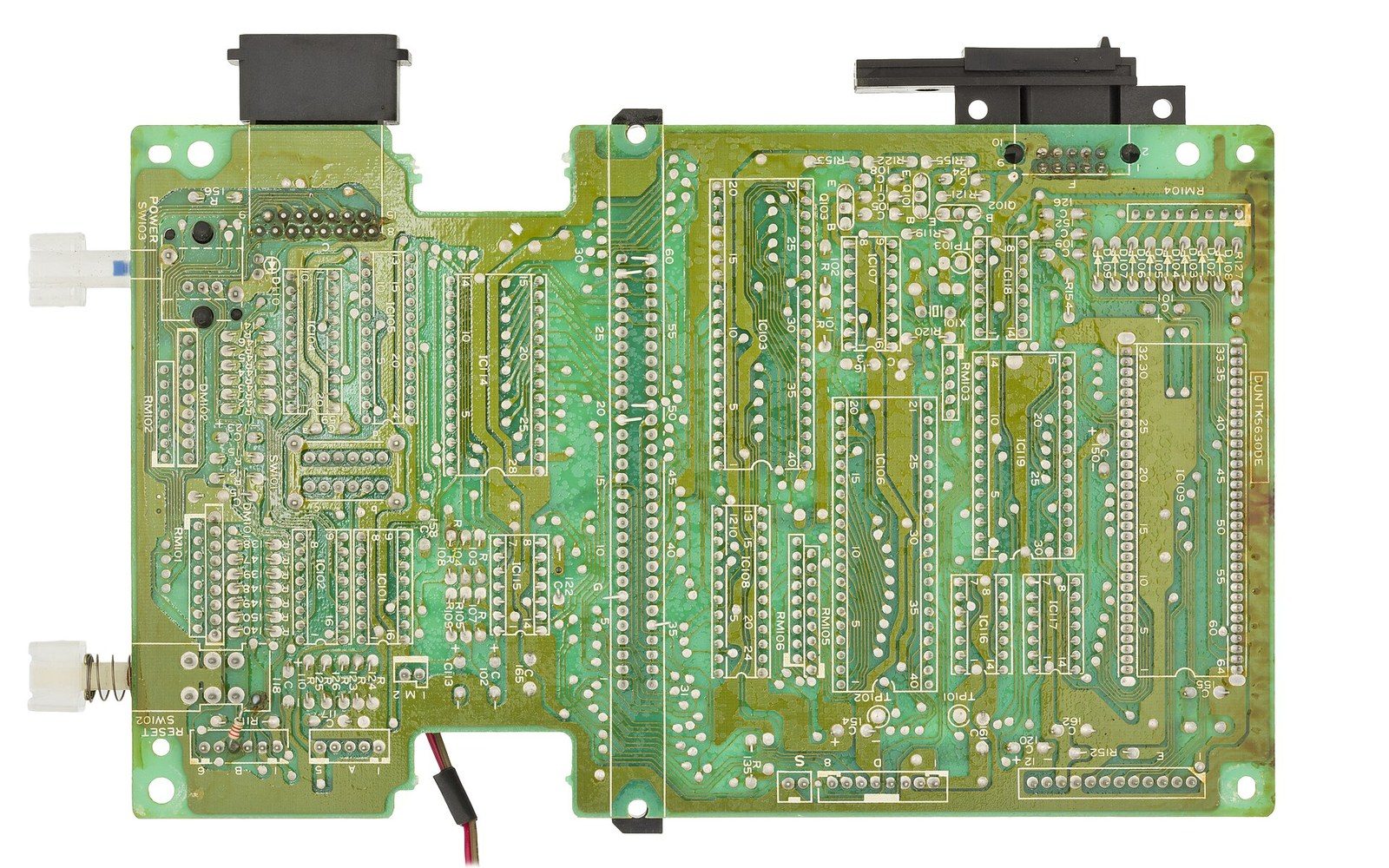
There are limits worth naming. The Game Boy's audio hardware operates at roughly 1 MHz for its internal clocking, and the DAC feeding the output is 4-bit per channel — meaning audible quantisation noise sits in the signal by default. The headphone amplifier on original hardware introduced its own colouration. These are not neutral monitoring conditions; they are another set of constraints, just different ones from the television speaker. Composers who wrote memorable Game Boy scores were not escaping hardware limitation — they were adapting to a new shape of it, one defined by proximity and stereo rather than distance and mono.
The 2A03 was built for a living room. The Game Boy was built for a commute, for a bedroom after lights-out, for ears a few centimetres from the source. Same ancestry, different physics, and music that sounds like it knows the difference.